
Looking At The Use Of L-serine and Potential Health Benefits/Risks

Researchers are looking into a new theory that may lead to a different approach in the treatment of Alzheimer’s disease. Recently on our Facebook page we shared an article about L-serine and the role that it may play on the prevention of Alzheimer’s disease and ALS. (The article can be found here. ) Paul Cox PhD, describes that “L-serine appears to be neuroprotective against all possible protein misfolding. It basically turns on a system in our brains that looks for unfolded proteins and is quickly poised to act on them.” He theorizes that L-serine “could significantly delay the onset of Alzheimer’s and the progress of its symptoms.”[6]

There is currently a Phase II clinical trial underway investigating the Effects of L-serine on Early Stage Alzheimer’s Disease Patients. Specific details of this trial can be found here. 

While reading about the research being done, I found myself wondering: What should consumers be aware of when buying this product? Is it safe? What are the risks? How do we even use it? Can you only get L-serine in supplement form? Here is what I found.

What is L-serine?

“L-serine is an amino acid essential for the synthesis of phosphatidylserine, which is a component of the membrane of brain cells (i.e., neurons).”[1]  It can be produced naturally in the body, but it can also be introduced into your body by the foods you eat or as a dietary supplement.

Are L-serine supplements safe? Have any risks been identified?

L-serine in dietary supplement form is identified as a “Generally Regarded As Safe” (GRAS) supplement compounded by the FDA. Research on the benefits and risks of L-serine on the body is still very new, and further research is needed to identify the effects of having too little or too much L-serine in the body. Always talk with your healthcare provider before adding any new supplements into your routine.

How do I use an L-serine supplement?

L-serine can be purchased in a capsule or powder form. There are many different brands available, and it is easily found in drug stores or online. That being said, it’s very important to do your research and make sure you are purchasing your supplements from a reputable source. The current Phase II clinical trial is administering L-serine in a gummy form, but those are not approved for over-the-counter sale at this time.

What should I look out for when shopping for products like this?

I mentioned earlier the importance of purchasing dietary supplements from reputable sources. The FDA has created a great page with resources for dietary supplement consumers, there is also a page for older dietary supplement users. Both pages provide information such as: Basic points to consider, tips for searching on the web, other tips and to-do’s, and how to spot fake or mismarketed products. Taking a look at this information will help you make informed decisions if you are considering the addition of new supplements to your daily routine. These pages can be found here  and here.

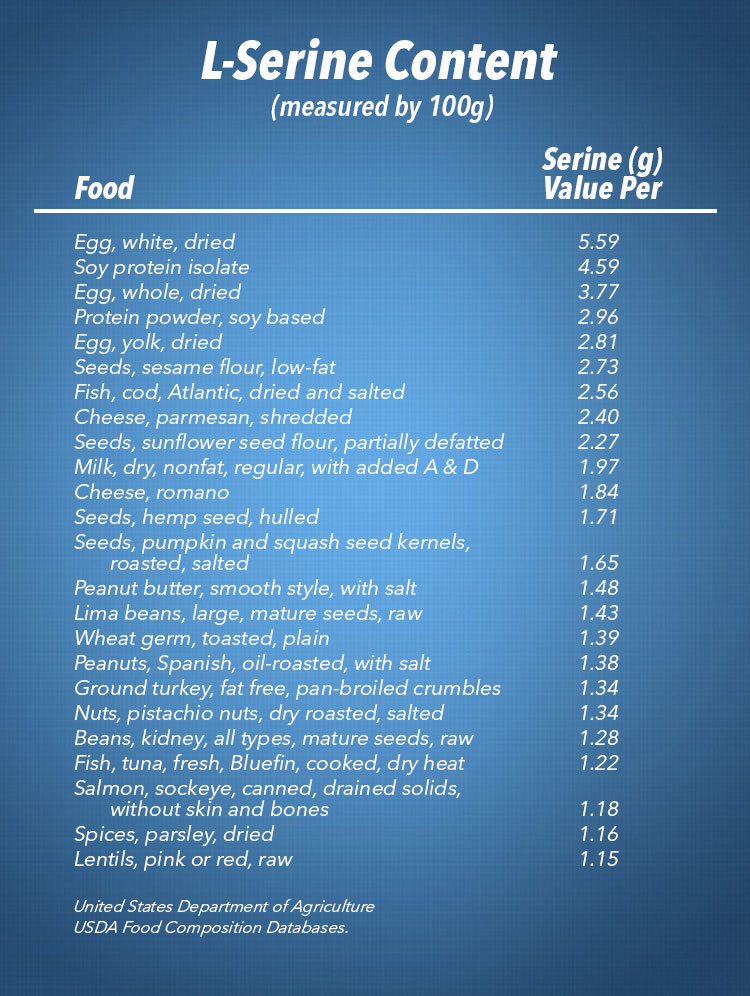
Are there other ways to increase L-serine without buying it as a dietary supplement?

Yes! There are many foods that are naturally high in L-serine. For those of you that would rather not add another supplement into the mix, here are some foods that are naturally high in L-serine.

Facebook
Twitter
Email
Sources:
1. L-Serine [Internet]. Alzheimer’s Drug Discovery Foundation. [cited 2019Mar25]. Available from: https://www.alzdiscovery.org/cognitive-vitality/ratings/l-serine#safety-block
2. Phase IIa L-serine Trial for eAD – Full Text View [Internet]. Phase IIa L-serine Trial for eAD – Full Text View – ClinicalTrials.gov. [cited 2019Mar25]. Available from: https://clinicaltrials.gov/ct2/show/NCT03062449
3. Center for Food Safety and Applied Nutrition. Information for Consumers – Tips for Dietary Supplement Users [Internet]. U S Food and Drug Administration Home Page. Center for Food Safety and Applied Nutrition; [cited 2019Mar25]. Available from: https://www.fda.gov/Food/DietarySupplements/UsingDietarySupplements/ucm110567.htm
4. What Is L-Serine and What Is Research Telling Us? [Internet]. Healthy Concepts with a Nutrition Bias. 2018 [cited 2019Mar25]. Available from: http://blog.naturalhealthyconcepts.com/2016/12/05/l-serine-als-research/
5. Center for Food Safety and Applied Nutrition. Information for Consumers – Tips for Older Dietary Supplement Users [Internet]. U S Food and Drug Administration Home Page. Center for Food Safety and Applied Nutrition; [cited 2019Mar25]. Available from: https://www.fda.gov/Food/DietarySupplements/UsingDietarySupplements/ucm110493.htm
6. Could This Radical New Approach to Alzheimer’s Lead to a Breakthrough? [Internet]. Fortune. [cited 2019Mar25]. Available from: http://fortune.com/longform/alzheimers-disease-cure-breakthrough/

FDA Cites 17 Companies For Illegally Marketing Dietary Supplements as Treatments For Dementia

For many ailments and conditions, over-the-counter products are readily available to help consumers find relief or treat various medical symptoms. When it comes to the relief and treatment of Alzheimer’s disease, there are many false claims being advertised about products that can “cure” the disease. This form of deceptive advertising is misleading vulnerable consumers to purchase fake treatments, and encouraging them to waste money on treatments that have not been properly reviewed by the FDA. “Brain health supplements make up more than $3 billion of the global market, and are predicted to reach $5.8 billion by 2032” (ALZFORUM, 2019).  Why? Because consumers are fearful of developing dementia and experiencing cognitive decline, while others are looking for ways to increase cognitive performance at work or school.

According to ALZFORUM, the press release made by the FDA on February 11, 2019 accused 17 companies of illegally marketing their products as dementia treatments. The supplements included vitamins, minerals, and herbal products. These products are unapproved or misbranded new drugs that claim to prevent, treat or cure Alzheimer’s disease and other serious health conditions. Selling them with this misbranding is in violation of the Federal Food, Drug, and Cosmetic Act. The FDA press release can be found here. The full ALZFORUM article can be read here. 

Several prescription drugs have been approved by the FDA for the treatment of people with an Alzheimer’s disease diagnosis such as: donepezil (Aricept®), rivastigmine (Exelon®), galantamine (Razadyne®), and memantine (Namenda®) (National Institute on Aging, 2016).  None of these drugs can cure or reverse the disease, but may provide symptom relief.

Clinical trials research is required for the FDA approval of new drugs to make sure they are effective and safe. To see what research opportunities are currently being offered at the Center for Cognitive Health, please fill out the How Can We Help You section at the bottom of this page or call (503) 548-0809. You may meet the criteria needed to help us test the efficacy of new drugs. 

To learn more about protecting yourself from fake treatments, take a look at this article provided by the FDA for consumers.

Facebook
Twitter
Email
Sources:
Alzheimer’s Disease Fact Sheet [Internet]. National Institute on Aging. U.S. Department of Health and Human Services; [cited 2019Mar15]. Available from: https://www.nia.nih.gov/health/alzheimers-disease-fact-sheet
 
Dementia Researchers Commend FDA Crackdown on Supplement Hype [Internet]. ALZFORUM. [cited 2019Mar15]. Available from: https://www.alzforum.org/news/community-news/dementia-researchers-commend-fda-crackdown-supplement-hype
 
Office of the Commissioner. Press Announcements – FDA takes action against 17 companies for illegally selling products claiming to treat Alzheimer’s disease [Internet]. U S Food and Drug Administration Home Page. Office of the Commissioner; [cited 2019Mar15]. Available from: https://www.fda.gov/NewsEvents/Newsroom/PressAnnouncements/ucm631064.htm
 
Office of the Commissioner. Consumer Updates – Watch Out for False Promises About So-Called Alzheimer’s Cures [Internet]. U S Food and Drug Administration Home Page. Office of the Commissioner; [cited 2019Mar15]. Available from: https://www.fda.gov/ForConsumers/ConsumerUpdates/ucm631046.htm