
The Relationship Between Amyloid, Tau, and Cognition

A recent article published on ALZFORUM discussed research from the first longitudinal study that conducted repeated scans on older adults for both amyloid and tau over several years, and correlate those PET scan results with cognitive changes.

Scans were analyzed from 60 men and women that took part in the Harvard Aging Brain Study who were cognitively healthy and between the ages of 65 and 85 years of age. In addition to the scans, the participants completed cognitive testing each year to monitor cognitive changes. Participants were divided into groups of high and low amyloid as measured from the initial scan.

Over the years of the study, amyloid and tau levels rose in both of the groups and cognitive scores decreased. Those with the faster rate of tau accumulation had the fastest cognitive decline. On average, this entire process was sped up in the group with higher levels of amyloid in the brain initially.

Amyloid is deposited in the brain years before symptoms of Alzheimer’s disease begin to appear. This makes amyloid PET scans the most useful tool in detecting early pathology of the disease.

The study mentioned above shows that a reduction of tau may help to preserve cognition in those with high amyloid accumulation.  

In brains without the presence of amyloid, the tau tangles stay confined to the medial temporal lobe as a part of normal aging. In brains where amyloid is present, the tau tangles invade the surrounding areas of the brain.

Studies support the theory that tau spreads through interconnected neurons, and that the spreading of tau depends of the presence of amyloid, as well as, the functional and structural connections between regions of the brain.

In addition to amyloid PET scans, tau PET scans are useful to track disease progression in clinical trials research. Currently, cognitive tests are helpful in tracking the progression, but take a long time to show any significant responses to clinical trials drugs.

Because amyloid may boost the accumulation of tau, people who accumulated amyloid at a fast rate throughout the study, experienced the most rapid increase of tau, and the largest cognitive decline.

Amyloid alone (without any presence of tau) has a weak affect on cognition, but as amyloid levels rise, it triggers a burst of tau production with ensuing cognition loss.

These findings help put the pieces in temportal order: amyloid, tau, and then cognitive decline. Tau PET biomarkers may get us closer to finding an effective disease modifying drug to combat Alzheimer’s disease. Larger studies will be needed to further evaluate this data and to fully understand the progression of this disease.
Facebook
Twitter
Email
Sources:
Serial PET Nails It: Preclinical AD Means Amyloid, Tau, then Cognitive Decline [Internet]. ALZFORUM. [cited 2019Jun19]. Available from: https://www.alzforum.org/news/research-news/serial-pet-nails-it-preclinical-ad-means-amyloid-tau-then-cognitive-decline

Early Changes In The Brain May Occur Decades Before The First Symptoms Of Alzheimer’s Disease Begin To Show.

Does Alzheimer’s disease pathology accumulate in our brains in our younger years without making us symptomatic?

Typically, individuals don’t get evaluated for Alzheimer’s disease (AD) or Mild Cognitive Impairment (MCI) unless they begin to notice a change in their memory or start to have other concerning symptoms that cue them that something may be going on with their brain health.

Research indicates that a decade or more before symptoms of MCI or AD appear, the neuropathological mechanisms associated with the development of Alzheimer’s disease may have already begun.

A recent study was done to evaluate changepoints in a range of biomarkers during preclinical (non-symptomatic) Alzheimer’s disease. Four measures were evaluated in this study including cerebrospinal fluid (CSF), magnetic resonance imaging (MRI), and cognitive testing. The study examined whether these measures had a significant change in relation to the onset of symptoms. The data was drawn from the BIOCARD study conducted at the National Institutes of Health (NIH) and Johns Hopkins University.

The study was made up of 306 cognitively normal individuals. A subset of these individuals progressed to the prodromal (symptomatic) phase of Alzheimer’s disease also called MCI. Approximately 75% of these participants had a first degree relative with AD.

The CSF measures analyzed the biomarkers  Abeta 42, the most toxic form of Abeta, total tau (t-tau), and phosphorylatedtau (p-tau, which make up the tangles in the brain). The MRI measures analyzed the entorhinal cortex, hippocampus, and the amygdala in the brain. The comprehensive neuropsychological battery tested all of the major cognitive domains including memory, executive function, language, visuospatial ability, attention, processing speed, and psychomotor speed. These were completed at baseline and at the onset of symptoms to examine the time association between performances.

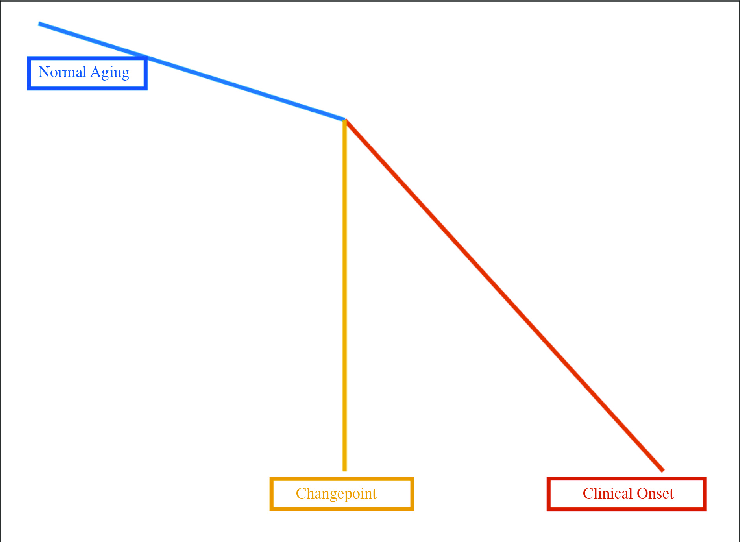
Using a changepoint analysis determined whether any of the measures discussed above had a significant changepoint in relation to the onset of clinical AD or MCI symptoms.

Photo: Schematic representation of the changepoint model

All of the measures that were studied had significant changepoints, and all of them preceded the onset of symptoms. The changepoint for CSF t-tau occurred 34 years prior to symptom onset. Although this changepoint appears to be associated with the onset of Alzheimer’s disease symptoms, it does not necessarily correspond to an early effect. All of the cognitive tests had changepoints 10-15 years prior to symptom onset, as well as the remaining CSF measures. The timing of these changepoints varied.

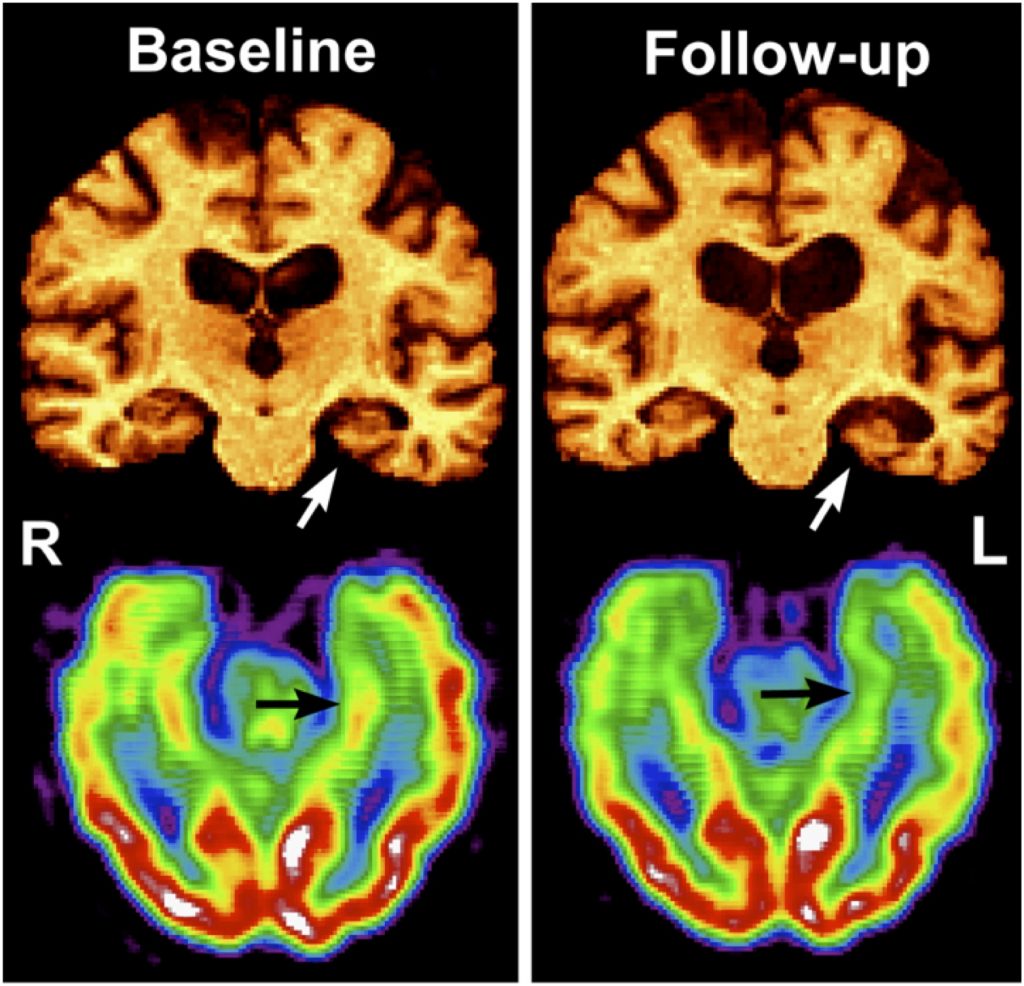
The study results provide a credible indication that a change in the biomarker occurs some number of years before clinical onset. However, an accurate prediction of the timing cannot be made due to the variability between individual experiences. The image below shows the change in hippocampal volume on MRI, and function on PET scan,in a patient with MCI over just a year.

We can expect to see further research in this area in the future due to the fact that it is challenging to  identify biomarker changepoints during the preclinical phase of Alzheimer’s disease.

Facebook
Twitter
Email
Sources:
Younes L, Albert M, Moghekar A, Soldan A, Pettigrew C, Miller M. Identifying Changepoints in Biomarkers During the Preclinical Phase of AD. 2018;
Google Images. Google; [cited 2019Jun19]. Available from: https://images.google.com/

Thelma’s Place, Winner of the Brodsky Innovation Grant!

Each year the Alzheimer’s Foundation of America awards a $25,000 grant to a nonprofit organization to help fund new programs or services within the community. To be considered for the Brodsky Innovation Grant the proposed program must seek to improve the lives of individuals living with Alzheimer’s disease and their families. It must also demonstrate creativity and uniqueness, fulfill a great need in the community, and demonstrate the potential to be replicated.

In 2018 Thelma’s Place in Canby, Oregon, received this grant to create The Garden of Life, an Intergenerational Sensory Garden. This garden has been designed to create an enriching, educational environment for both individuals with Alzheimer’s disease and pre-school aged children.

Gardens provide safe opportunities for interaction and relaxation between seniors and children. The intergenerational Sensory Garden at Thelma’s Place is an interactive experience that allows those with Alzheimer’s disease and children to stimulate their minds together, be creative and have fun. Having a space like this available allows individuals with Alzheimer’s disease to feel empowered, improve self-esteem and positively impact their overall well-being.

Those who visit the Sensory Garden can experience increased connectedness, renewed purpose for living, enhanced feelings of self worth, improved behaviors, an opportunity to laugh and the unconditional love with children who are in need of an enhanced sense of belonging, empathy and development.

The Garden of Life is comprised of different stations that are each intended to produce various results. Stations include a Sound Garden, Exploration Garden, Tasting Garden, and an Observation Garden. These stations allow for creative expression, stress release, imagination and much more.

Thelma’s place is a non-profit organization in the community that provides breaks for caregivers to re-energize while their loved one visits the day center to participate in daily activities that are specially designed for those with memory loss. Day trips and activities such as visiting places within the community and nearby areas are also planned for those who attend the day center. Whether a person has just been diagnosed with a memory condition, is coping with Alzheimer’ daily, or experiencing memory problems of any kind; all are welcome at Thelma’s Place.

Caregivers are able to take time for themselves and also attend support groups and education related to being a caregiver, while their loved ones participate and enjoy the daily activities that Thelma’s Place has to offer.

Here is a great video about Thelma’s Place!

Facebook
Twitter
Email
Sources: 
Alzheimer’s Foundation of America Chooses Thelma’s Place, of Canby, Oregon, as National Winner of its Brodsky Innovation Grant [Internet]. Alzheimer’s Foundation of America. 2018 [cited 2019Jun10]. Available from: https://alzfdn.org/alzheimers-foundation-america-chooses-thelmas-place-canby-oregon-national-winner-brodsky-innovation-grant/
Home [Internet]. Thelma’s Place. [cited 2019Jun10]. Available from: http://thelmasplace.org/
Rosen C. Thelma’s Place wins $25,000 innovation grant [Internet]. https://joomlakave.com. 2018 [cited 2019Jun10]. Available from: https://pamplinmedia.com/cby/147-news/401831-298212-thelmas-place-wins-25000-innovation-grant-

What Is The AFA and What Do They Do?

The Alzheimer’s Foundation of America is an organization that provides support and education to those living with Alzheimer’s disease, as well as, their caregivers and families. The AFA also helps to fund research on improved treatments in the hope of finding a cure for Alzheimer’s disease.

The AFA website offers a National Toll-Free Helpline. This resource is available 7 days a week and is staffed by licensed social workers. The neat thing about this help line is that, although they are based out of New York, they are also able to connect callers with local resources in their area throughout the United States. There are multiple ways to access this help line. You can call the number, 866-232-8484, or they offer Live Chat, Skype, and Email options as well.

Telephone Support Groups are also offered for caregivers and are led by licensed social workers. This option allows for those who can’t always make it to local in-person group meetings or those with busy schedules to receive the support they need.

Fact Sheets are available on the AFA website and cover a wide range of topics such as what to do after being diagnosed, sleep tips, tips for traveling, tips for talking about memory changes, incontinence, fall prevention, eating tips and much more.

Webinars are held frequently and discuss topics surrounding Alzheimer’s disease. These can be accessed later if you cannot attend during the scheduled time.

The Alzheimer’s Foundation of America also has a National Memory Screening Program. Memory screens are essential to early diagnosis of Alzheimer’s disease. They may also help diagnose other conditions that cause memory problems. Although we are still looking for a cure for Alzheimer’s disease, other conditions that cause memory problems may be treatable such as vitamin deficiencies or thyroid problems.

These free memory screens are provided across the United States. Screening sites near you can be found by clicking here. Your doctor may also provide memory screens, so be sure to ask them for more information.

The AFA is currently running their Educating America Tour and will be making a stop in Portland, OR on June 11th, 2019! This conference is free to attend and open to the public.

The conference will be held from 9:00am-1:30pm at the Oregon Museum of Science and Industry located at 1945 SE Water Avenue, Portland, OR 97214.

Center for Cognitive Health’s own Dr. Michael Mega is the keynote speaker at this event and will be giving a talk titled Unraveling Alzheimer’s. Dr. Mega will provide an overview of Alzheimer’s disease, an update on Alzheimer’s research and clinical trials, and what we can expect on the horizon.

The conference is offering additional workshops and free, confidential memory screens.

The other workshop topics include:

  • Preparing for and Understanding Long Term Care
  • Creating Innovative Intergenerational Programming and Therapeutics

The free memory screens done at this conference are a great resource that can provide insight on whether or not a follow-up is needed for further testing and evaluation. The earlier that memory changes can be identified, the better. Results from these screenings will be available for you to add to your medical records. There are 4 tests involved in the screenings and will be done in a private, one-on-one setting with trained test administrators. It is very important to remember that these tests are not used to diagnose any medical conditions. An official diagnosis needs to be given by your doctor.

If you are unsure whether or not you should have a memory screen, Here is a link to some questions that might help you decide. 

Hope to see you there!

Facebook
Twitter
Email
Sources:
Alzheimer’s Foundation of America [Internet]. Alzheimer’s Foundation of America. [cited 2019Jun4]. Available from: https://alzfdn.org/