
The Alzheimer Epidemic: Urgent Treatment Needed Now

It is normal for our brains to shrink as we age but abnormal to lose basic cognitive function or brain cells in large numbers.  Alzheimer’s disease kills our brain cells, known as neurons, leading to thinking and memory decline. Overtime, affected individuals will gradually lose their ability to live independently. Over 5 million Americans have Alzheimer’s disease, 65,000 of those individuals reside in Oregon with another 110,000 in Washington. Between 2017 and 2018 there was a $20 billion rise in total care spent for individuals suffering from Alzheimer’s disease. It is becoming increasingly clear that better treatments are needed now more than ever.

Naturally occurring amyloid protein collect between neurons to form plaques.  Abnormally folded tau protein forms neurofibrillary tangles inside neurons blocking their transport system and preventing communication with other neurons. When neurons are damaged connections between neural networks degrade causing brain regions to shrink, or atrophy (see Figure 1 showing brain shrinkage over a one year period in a patient with early disease). The brain areas most affected are responsible for memory, as the disease progresses it continues to affect other regions essential for language, reasoning, and more.
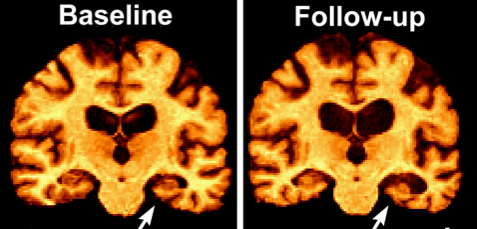
Figure 1. MRI scans of patient with MCI at baseline and 1 year later in follow-up; arrows point to the memory circuit called the hippocampus which has rapidly atrophied.

The disease can be divided into three stages. The first stage is called preclinical Alzheimer’s disease where subtle cognitive changes occur and often go unnoticed. The second stage–prodromal Alzheimer’s disease–or mild cognitive impairment (MCI), is when memory problems become obvious to family members, but the affected person can still live alone. The last stage is called Alzheimer’s disease dementia, where the individual’s ability to perform independent activities of daily living is impaired.

An Alzheimer’s diagnosis is confirmed by clinical interpretation and biomarker identification by measuring amyloid in the cerebral spinal fluid or with Amyloid-PET (Positron Emission Tomography) scans. These scans make it possible for us to view the amyloid plaques and, with Tau-PET, the tangles within the brain; allowing us to identify individuals at risk for the disease even before symptoms arise. Unfortunately, these PET scans are very expensive, slightly invasive, and often times not covered by insurance, including Medicare. Establishing a blood test to detect at risk individuals is urgent. Numerous research groups have been working towards this goal with one test, by the company Shimadzu Corp, being 88% accurate at identifying those at risk. Early detection of the disease is necessary as we have learned that anti-amyloid drugs do not work in individuals with prodromal or full-blown Alzheimer’s disease.

There are few treatment options currently available, drugs like Aricept and Namenda, only successfully treat symptoms in a minority of patients. There is no cure for Alzheimer’s disease. The need for a disease modifying agent to combat Alzheimer’s disease is growing. New drugs are being tested to halt the progression or prevent the initiation of the disease. The most common targets for these drugs are amyloid protein, tau protein, and the brain inflammation these mis-folded proteins cause.

A change has recently occurred within Alzheimer’s disease research. The lack of efficacy of anti-amyloid drugs in people with symptoms has motivated researchers to target factors other than amyloid, such as the mis-folded tau protein, and brain inflammation. Our fight against Alzheimer’s disease continues at the Center for Cognitive Health as we continue to work within the global research community seeking the first ever FDA-approved disease modifying medication for Alzheimer’s disease. 
Facebook
Twitter
Email

The Village Landais Alzheimer – France’s New Care Facility

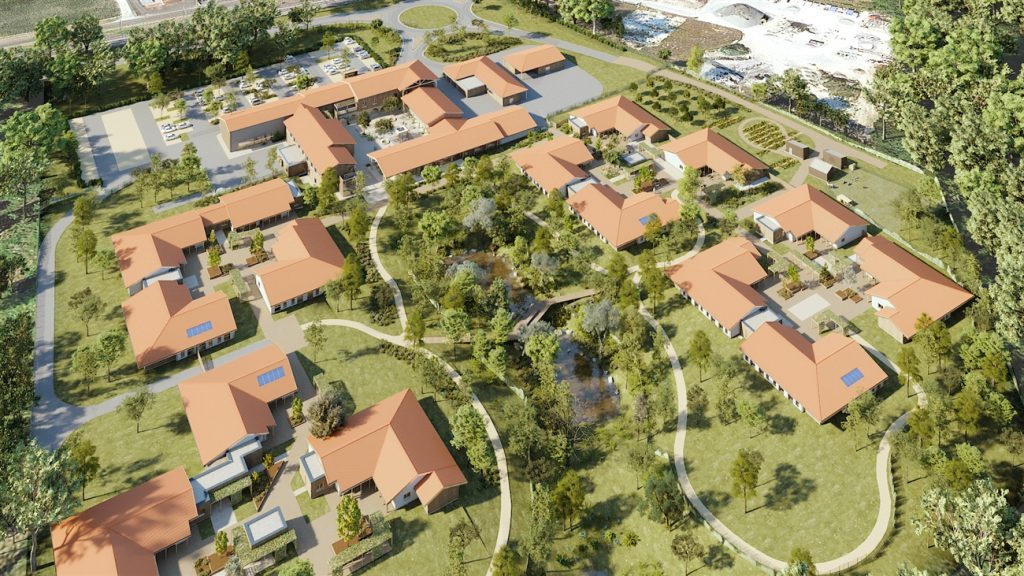
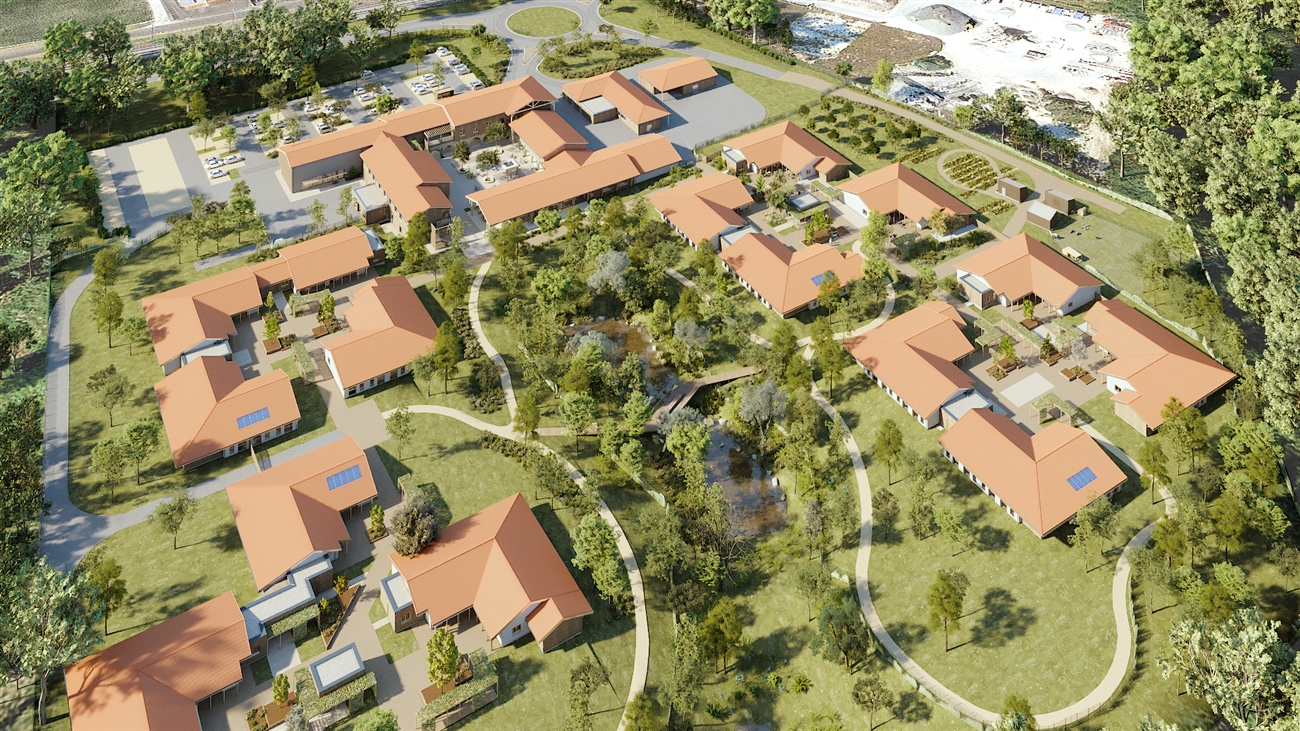
A 17-acre elderly care village named Landais Alzheimer is currently being built near the city of Dax nestled in southwestern France. It may appear to be a senior living community like any other, but it’s unique in that it’s a village developed entirely for men and women suffering from Alzheimer’s disease (AD).

Henri Emmanuelli developed the idea after reading about a similarly established care facility for individuals with dementia in the Netherlands. Largely governmentally funded, the Village Landais Alzheimer is anticipated to cost around $36 million dollars once completed, with an expected daily resident cost of only $82 per day, which is comparable to the daily rate for traditional French nursing homes. Now-a-days, with increasing costs of care as we age, not everyone can attend a private care facility or maintain the ability to stay home despite help. The Village Landais Alzheimer is Henri’s solution.

The Village

The community is equipped with a salon, gym, restaurant, garden, 5-acre park, library, and even a small farm! Residents will maintain a sense of independence and normality by shopping in a small supermarket for their individual needs, and most importantly, in a safe space developed especially for them. The architecture will allow for residents to walk, navigate, and orient themselves within the community, something that can often prove challenging for individuals with AD.

The houses are arranged in four square-like districts that surround a central commons ground offering most amenities and an auditorium. Residents will share housing designed to respect various lifestyles and their independence and privacy, offering a familiar family way of life. Sixteen houses with 7-8 residents will reside in one of four neighborhoods. All attempts were made to make the village feel as if it’s a regular, every-day village. The neighborhoods are named after nearby towns found between Frances southwestern sea and forest, and are designed with styles to match. To help patients feel appropriately oriented the village used a more traditional and familiar look of a medieval fortified town, common in this region of France, rather than modern architecture.

Medical staff without any visible identifiers and in plain clothing will watch over residents as they go about their daily lives and may provide care if needed. Trained volunteers will be present for daily activities that sometimes consist of outside events, like sports games and plays. These volunteers, mostly from the surrounding community, will breathe life into the village and provide a link between the village and the ‘outside world’. The facility will not be an isolated village, but rather open to the town of Dax, which will help to introduce further culture. Trained dogs will also be available to prevent the psychosocial isolation often accompanied with aging and AD. 

Why create an entire community dedicated to people with AD?

It will allow individuals with AD to increase their freedom while also reducing anxiety, which is a side effect highly associated with AD. The facility is hoped to create a sense of normality, community, and continuity between pre and post AD diagnosis, with an emphasis on maintaining socialization. Advocates for the village expect residents to be happier with increased activity and less required medication when compared to traditional living facilities. The fact that a place exists specifically catered to caring for loved one’s with AD, without sacrificing quality of life, should also help to lessen the worry of friends and family.

Unlike the already established Dutch site in the Netherlands, 120 young researchers will cohabitate with the Alzheimer’s residents along with 100 live-in caretakers and 120 volunteers. The researchers will identify the impact of their residential approach on patients, caregivers, and medical staff with a comparative study with traditional nursing homes. The facility is expected to open at the end of 2019. Depending on the results of the associated research, it may change the way we currently view residential housing for individuals with AD.

The following video will take you on a tour of the village. Although it has not been translated into english, it provides a nice visual of its set up and accomodations.

Facebook
Twitter
Email
Sources: 
“France Builds First Alzheimer’s ‘Village’ in Pioneering Experiment.” BBC News, BBC, 5 June 2018, www.bbc.com/news/world-europe-44376247.
“La Maladie.” Village Alzheimer, villagealzheimer.landes.fr/la-maladie.
Samuel, Henry. “France Starts Work on Revolutionary ‘Alzheimer’s Village’ Where Patients Roam Almost Free.” The Telegraph, Telegraph Media Group, 4 June 2018, www.telegraph.co.uk/news/2018/06/04/france-starts-work-revolutionary-alzheimers-village-patients/.