Introduction to Neuroinflammation

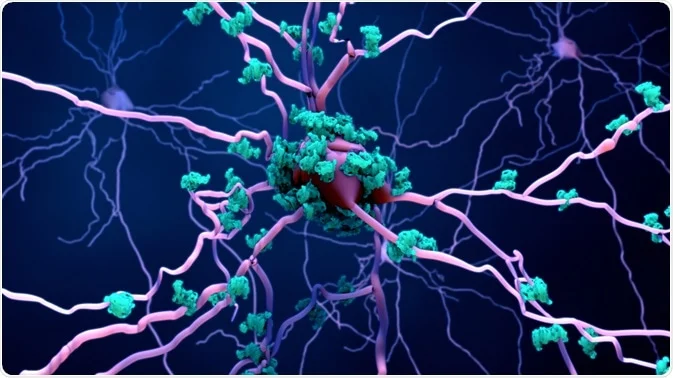
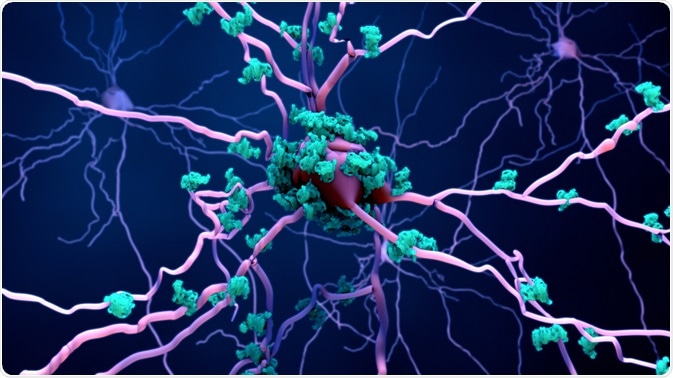
       When our bodies are threatened by an invasive, harmful material – like a virus or a toxic chemical – our immune system responds quickly with inflammation. Neutrophils, macrophages, and lymphocytes are some of the most important cells involved in this process, allowing for regulation of the inflammatory response. This inflammatory response occurs in the brain, too, and is known as neuroinflammation. When neuroinflammation occurs, specialized cells in the brain known as astrocytes and microglia become activated, and inflammatory mediators are released.

       When activated microglia release inflammatory mediators, the blood brain barrier is weakened, allowing immune cells to enter the central nervous system from the periphery of the body to assist with the inflammatory response. The balance of these mediators is crucial, as the immune system must respond to the bodily threat without causing enough inflammation to damage the brain. As such, these mediators – known as chemokines and cytokines – may be neuroprotective or neuroinflammatory. For example, a chemokine known as MCP-1 (monocyte chemoattractant protein-1) is responsible for regulating the migration of monocytes and T-cell lymphocytes toward the affected area, so it is neuroinflammatory. Conversely, activation of the GLP-1 (glucagon-like peptide 1) receptor shifts microglia from one subtype to another, inhibiting production of astrocytes and reducing inflammation.

       In Alzheimer’s disease, the accumulation of misfolded amyloid beta and tau proteins is associated with neuroinflammation. These misfolded proteins are perceived as harmful, thereby activating the inflammatory response. This creates a state of chronic inflammation, wherein the continuous inflammatory response begins to cause neuronal damage, contributing to the neurodegeneration associated with Alzheimer’s disease. For this reason, drugs that suppress the inflammatory response are being studied in Alzheimer’s disease.

       A new study drug known as VHB9327 is being researched for its effects on TREM2, a receptor activated and upregulated in response to central nervous system injury. TREM2 allows microglia to transition to a specialized subtype known as disease-associated microglia. Disease-associated microglia emerge in response to neurodegenerative diseases, have a unique upregulation and downregulation of genes, and assist in the clearing of toxic aggregates of protein. Because TREM2 promotes disease-associated microglia, it is hypothesized that using VHB9327 to selectively activate TREM2 will skew microglia toward a neuroprotective, anti-inflammatory phenotype.

       Preclinical studies in animal models have corroborated the above hypothesis, and VHB9327 is now being studied in clinical trials for Alzheimer’s disease. Key criteria for study eligibility includes a diagnosis of mild cognitive impairment or Alzheimer’s disease, a confirmation using cerebrospinal fluid or amyloid PET scan, and being between ages 50-85 at the start of the study. Exclusion criteria includes dementia for a reason other than AD, stroke in the last 12 months, use of anticoagulants, presence of cancer, or presence of any other neurological disease. The study will gather information about the effects of VHB937 on memory, cognition, daily activities, and brain imaging. Approximately 400 participants will receive either VHB9327 or placebo for 72 weeks. This is followed by an extension period where all participants will receive VHB9327. Publicly available information about the trial can be found here: https://clinicaltrials.gov/study/NCT07094516.
 

Facebook
Twitter
Email

Sources


Adamu, Alhamdu, et al. “The Role of Neuroinflammation in Neurodegenerative Diseases: Current Understanding and Future Therapeutic Targets.” Frontiers, Frontiers, 11 Apr. 2024, www.frontiersin.org/journals/aging-neuroscience/articles/10.3389/fnagi.2024.1347987/full.

DiSabato, Damon J, et al. “Neuroinflammation: The Devil Is in the Details.” Journal of Neurochemistry, U.S. National Library of Medicine, 4 May 2016, pmc.ncbi.nlm.nih.gov/articles/PMC5025335/.

Kölliker-Frers, Rodolfo, et al. “Neuroinflammation: An Integrating Overview of Reactive-Neuroimmune Cell Interactions in Health and Disease.” Mediators of Inflammation, U.S. National Library of Medicine, 31 May 2021, pmc.ncbi.nlm.nih.gov/articles/PMC8187052/.

Labuda, Victoria, and Masilan A. Sundara. “The Role of Disease-Associated Microglia in Neurodegenerative Disease: A Review.” Undergraduate Research in Natural and Clinical Science and Technology Journal, 3 May 2024, urncst.com/index.php/urncst/article/view/575.

Sobue, Akira, et al. “Neuroinflammation in Alzheimer’s Disease: Microglial Signature and Their Relevance to Disease – Inflammation and Regeneration.” BioMed Central, BioMed Central, 10 May 2023, inflammregen.biomedcentral.com/articles/10.1186/s41232-023-00277-3.

Stangel, Martin, et al. “VHB937, a TREM2 Stabilizing and Activating Antibody Strongly Reduces Pathology After Peripheral Administration in a Broad Range of Animal Models for Neuroinflammation and Neurodegeneration.” Neurology, Neurology, 9 Apr. 2024, https://www.neurology.org/doi/10.1212/WNL.0000000000205610.

Zhang, Weifeng, et al. “Role of Neuroinflammation in Neurodegeneration Development.” Nature News, Nature Publishing Group, 12 July 2023, www.nature.com/articles/s41392-023-01486-5.

Lithium's importance in the brain

Lithium Deficiency and its possible role in Cognitive Decline

Lithium's importance in the brain

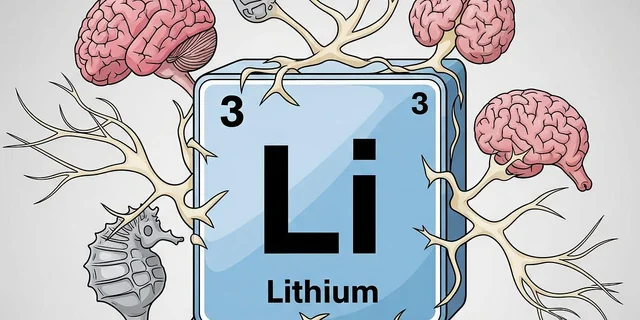
       Lithium’s impact on cognition has garnered a lot of attention in recent weeks. An article published in Nature, suggests that lithium deficiency could be a factor in the pathogenesis of Alzheimer’s Disease (AD). Specifically, a lithium salt, known as Lithium Orotate (LiO), was shown to prevent pathological changes and memory loss in wild elderly and transgenic AD mice.

       The body of research behind lithium is extensive, from modern energy storage to modern medicine. With major focuses on Lithium-ion batteries and mood stabilization for treating bipolar disease. Lithium is the lightest metal with the highest electrochemical potential on the periodic table, meaning it has the incredible ability to store the most amount of energy relevant to its weight. It is theorized that our brains have used lithium’s electrochemical potential long before the advent of the Lithium-ion battery.

       This recent study using LiO in mouse models generates much hope in the fight against AD. Three types of mice, when fed a lithium-deficient diet, showed increased signs and precursors of AD. Specifically, they found that lithium-deficient, elderly wild-type mice were found to have elevated levels of amyloid-beta-42, a precursor of AD, as compared to the control group. This, along with other findings noted in the journal article, prompt many more questions around the idea of Lithium being an important element in our brain chemistry.

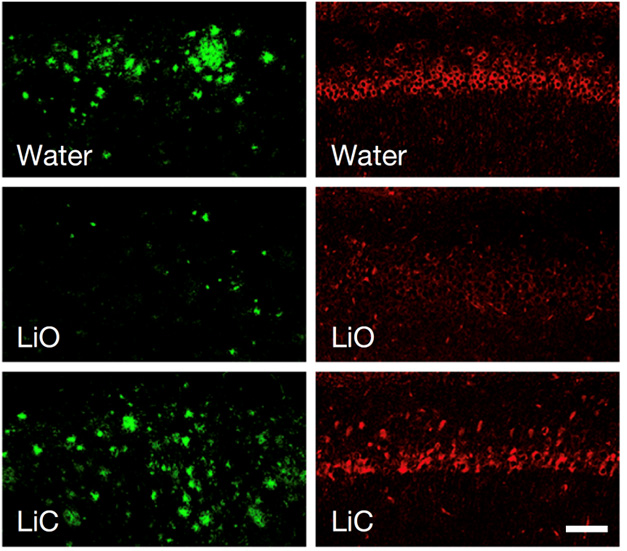
The figure below depicts another phenomenon:

Lithium in Mice Models

       The green represents amyloid plaque, and the red represents phospho-tau in the hippocampal regions of transgenic mice with AD mutations. These mutations allow the mice to present with plaque and tangle buildup, as in humans. This figure shows that LiO leads to a decrease in amyloid plaque and phospho-tau buildup compared to water and Lithium Carbonate (LiC).

       The article presents many fascinating findings and urges more studies to be performed to further explore the potential benefits of Lithium. It is still unclear whether these findings in mice will present similar findings in human subjects, but there is a lot of hope around the topic. The dose of LiO the mice got was 1000 times lower than the dose of LiC that is often given to humans for bipolar disorder (1.2 g/day); that would suggest the equivalent human dose of LiO would be 150 mg/day.

Facebook
X
Email

Sources:

Aron, L., Ngian, Z. K., Qiu, C., Choi, J., et al. (2025). Lithium deficiency and the onset of Alzheimer’s disease. Nature, 10.1038/s41586-025-09335-x. Advance online publication.

Could Lithium Deficiency Be Powering Alzheimer’s? ALZFORUM. (2025, August 13) https://www.alzforum.org/news/conference-coverage/could-lithium-deficiency-be-powering-alzheimers

Xanamem: Targeting Cortisol to Combat Cognitive Decline


When stressed, your body releases high levels of cortisol — the so-called “stress hormone.” While cortisol plays a helpful role in short bursts (like helping you respond quickly to danger), prolonged exposure can damage areas of the brain crucial for memory and decision-making, particularly the hippocampus and prefrontal cortex. 

Chronic cortisol elevation in older adults accelerates neuronal death through multiple pathways. It increases glutamate activity, leading to excitotoxic damage in the hippocampus, and disrupts mitochondrial function. Cortisol also reduces BDNF, limiting neuroplasticity, and triggers microglial activation, promoting neuroinflammation. Additionally, it shortens telomeres, speeding up neuronal aging. Over time, this can lead to mental fog, memory loss, and an increased risk of cognitive decline.

Xanamem, developed by Actinogen Medical, is designed to block the production of cortisol inside brain cells. Unlike traditional cortisol blockers that affect the whole body, Xanamem targets a specific enzyme called 11β-HSD1, which is responsible for producing active cortisol in the brain. By reducing cortisol levels locally, Xanamem aims to shield the brain from stress-related damage — without disrupting the hormone’s role in other parts of the body.


Early trials have shown encouraging results, particularly in older adults experiencing early signs of cognitive impairment. A 2021 trial in AD subjects showed significant improvements in memory and executive function- i.e. processing speed and problem-solving, but did not show significant improvements in AD biomarkers. Researchers hope Xanamem could become a key player in treating — or even preventing — conditions like Alzheimer’s disease, while also supporting everyday brain health in people under chronic stress, but more research is needed.

Facebook
X
Email
Sources:
Alzforum. (2023, July 21). Non-Aβ, non-tau drugs tweak markers, cognition in Alzheimer’s, Huntington’s. Alzforum. https://www.alzforum.org/news/conference-coverage/non-av-non-tau-drugs-tweak-markers-cognition-alzheimers-huntingtons
Alzforum. (n.d.). Xanamem. Alzforum Therapeutics. https://www.alzforum.org/therapeutics/xanamem
Alzforum. (n.d.). Brain 11β-hydroxysteroid dehydrogenase type 1 occupancy by XanamemTM assessed by PET in Alzheimer’s. Alzforum. https://www.alzforum.org/papers/brain-11v-hydroxysteroid-dehydrogenase-type-1-occupancy-xanamemtm-assessed-pet-alzheimers
Bush, A. I., Sohrabi, H. R., Kanagasingam, Y., Weinborn, M., Verdile, G., & Martins, R. N. (2023). Plasma pTau181 predicts clinical progression in a phase 2 randomized controlled trial of an 11β-HSD1 inhibitor (Xanamem). Alzforum. https://www.alzforum.org/papers/plasma-ptau181-predicts-clinical-progression-phase-2-randomized-controlled-trial-11v-hsd1
Griffiths, K., Sohrabi, H. R., Weinborn, M., Weinborn, M., & Martins, R. N. (2022). The cortisol hypothesis of Alzheimer’s disease: A review of the evidence. Journal of Alzheimer’s Disease, 90(2), 323–341. https://doi.org/10.3233/JAD-220542
Lupien, S. J., et al. (1998). The effects of stress and stress hormones on human cognition: Implications for the aging brain. Psychoneuroendocrinology, 23(1), 1–23. https://doi.org/10.1016/S0306-4530(97)00003-1

ONO-2020: Can Epigenetics be a New Path in Alzheimer’s Disease Research?

       ONO-2020 is a new type of drug targeting epigenetic pathways in Alzheimer’s Disease (AD) hopefully leading to better memory and cognition. The idea is that with the right amount of epigenetic modulation, there might be beneficial effects on AD related symptoms.

       Epigenetics explores how the environment and our behavior modifies the expression of genes without changing DNA. Epigenetics could describe the behavioral differences in our offspring. Epigenetics is impacted by environmental factors; diet, stress, toxins, and lifestyle choices and is targeted by drug developers to change how cells function in progressive diseases, i.e. diabetes, cancer, and AD treatments.

       The clinical trial is a phase II, double-blind, parallel-group, placebo-controlled study to assess safety, tolerability, pharmacokinetics, and efficacy of ONO-2020 in patients with mild to moderate AD. There is still a lot of research to be done to determine if ONO-2020 will be an important emerging drug to combat AD progression. This clinical trial is one step in a long process to prove the safety and efficacy of one of many evolving epigenetic modifiers in AD therapy.

Facebook
X
Email
Sources:
Shivraj Sohur U, O’Neill S, et al. (2025). A Study of ONO-2020 in Participants with Mild to Moderate Alzheimer’s Disease. Gov, Ono Pharmaceutical Co. Ltd. clinicaltrials.gov/study/NCT06881836?cond=Alzheimer%27s+Disease.


Jianbing Men, Xinyue Wang, Yunnuo Zhou, Yumeng Huang, Yue Zheng, Yingze Wang, Shuang Yang, Nan Chen, Nan Yan, Xiaoxu Duan. (2025). Neurodegenerative diseases: Epigenetic regulatory mechanisms and therapeutic potential. Cellular Signalling. 131(1).


Gibney ER, Nolan CM. (2010). Epigenetics and gene expression. Hereditary. 105(1), 4-13.